
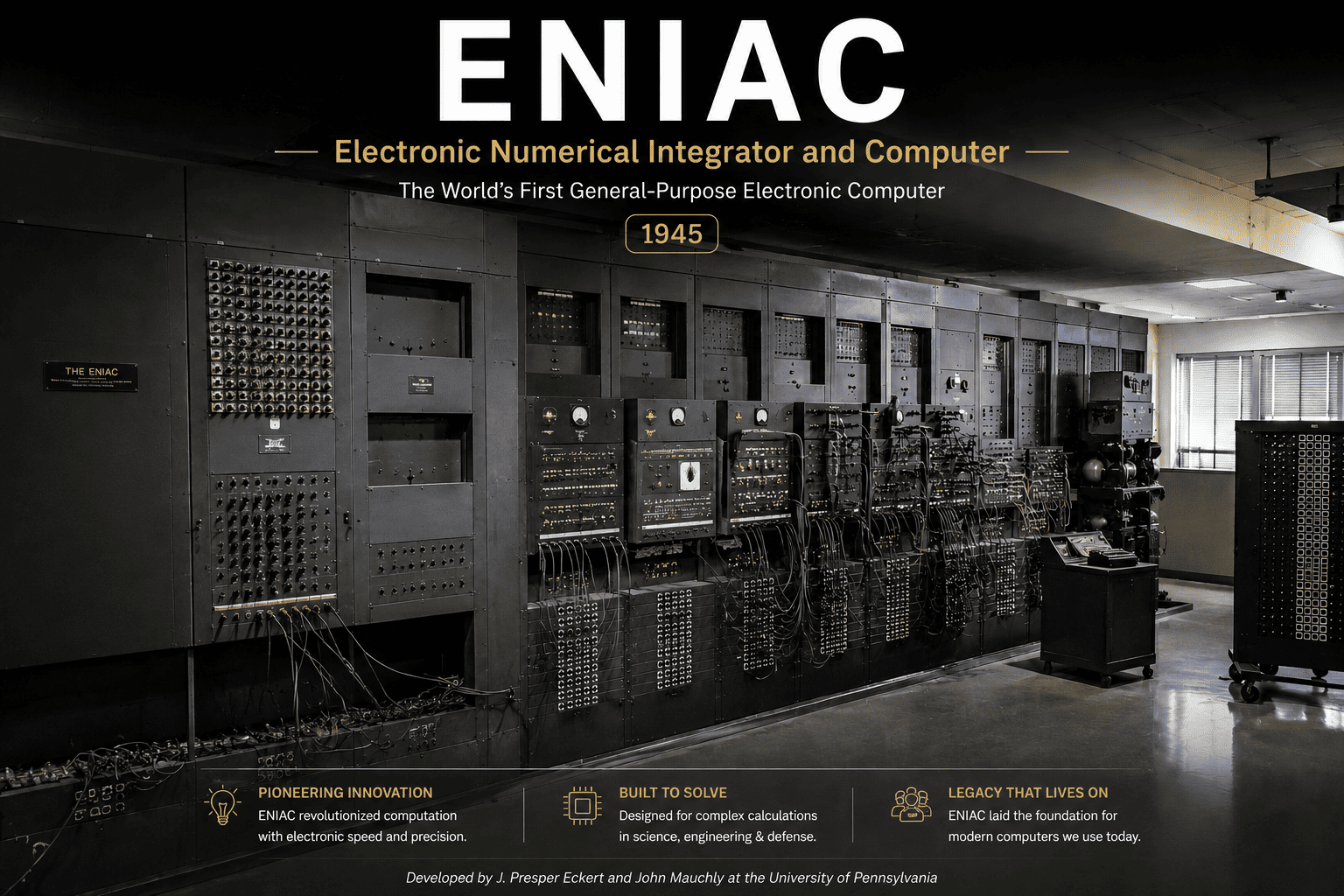
The history of modern computing began with a few remarkable inventions, and ENIAC stands among the greatest of them. Before computers became small enough to fit into our pockets, engineers built enormous machines that occupied entire rooms. These early systems proved that electronic machines could solve complex mathematical problems much faster than humans.
One such revolutionary machine was the Electronic Numerical Integrator and Computer (ENIAC). It changed the world of computing forever and laid the foundation for today’s desktops, laptops, smartphones, cloud servers, and supercomputers.
Although ENIAC was designed more than seventy years ago, computer scientists and engineers still study it because many modern computing concepts originated from this historic machine.
Whether you are a school student, a beginner learning computers, or an aspiring IT professional, understanding ENIAC will help you appreciate how computing has evolved over time.
What Is ENIAC?
Imagine trying to solve thousands of difficult mathematical calculations using only paper and a pencil. Even a team of skilled mathematicians would need several days or weeks to finish the work.
Now imagine a machine that could complete the same calculations in just a few seconds.
That machine was ENIAC.
Just starting out with computers? You’re in the right place! This tutorial is part of our Computer Fundamentals series, designed to help beginners understand essential concepts in a simple way.
ENIAC – Electronic Numerical Integrator And Computer
ENIAC (Electronic Numerical Integrator and Computer) was the world’s first large-scale, general-purpose electronic digital computer. Engineers designed it to perform complex calculations much faster than any machine available at that time.
Unlike mechanical calculators that relied on moving gears and rotating parts, ENIAC used thousands of electronic components to process information. As a result, it could perform calculations at unprecedented speeds, making it one of the greatest technological breakthroughs of the twentieth century.
Although ENIAC appears enormous by today’s standards, it introduced ideas that influenced nearly every computer built afterwards.
ENIAC – Simple Definition:
ENIAC was one of the first electronic computers capable of solving a wide variety of mathematical problems much faster than humans or mechanical calculators.
What Does ENIAC Stand For?
ENIAC stands for: Electronic Numerical Integrator and Computer
Let’s understand each word.
Electronic: Uses electronic components instead of mechanical parts.
Numerical: Works mainly with numbers and mathematical calculations.
Integrator: Combines many calculations to solve larger mathematical problems.
Computer: A machine that processes data according to instructions.
Together, the name describes a machine designed to perform electronic numerical calculations quickly and accurately.
Why Was ENIAC Invented?
Every invention solves a problem, and ENIAC was no exception.
During World War II, the United States Army needed accurate firing tables for artillery weapons.
A firing table helps soldiers determine:
- the angle of the cannon,
- the amount of gunpowder,
- the expected distance,
- and where the projectile will land.
At that time, people known as human computers performed these calculations manually. Even with mechanical calculators, producing a single firing table could take many hours or even several days.
This process created two major problems.
It Was Too Slow
Military operations required quick decisions. Waiting days for calculations was impractical.
Human Errors Could Occur
Long calculations increased the chances of mistakes, which could affect accuracy.
To solve these challenges, engineers developed ENIAC.
Instead of relying on people to perform repetitive calculations, ENIAC automated the process electronically. Consequently, it completed mathematical operations thousands of times faster than manual methods.
Soon, scientists realised that ENIAC could solve many other scientific and engineering problems beyond military applications.
History of ENIAC
The idea of ENIAC emerged during World War II when governments needed faster methods for scientific computation.
In 1943, the U.S. Army funded a project at the Moore School of Electrical Engineering, University of Pennsylvania.
The objective was straightforward:
Build an electronic machine capable of solving mathematical problems significantly faster than existing equipment.
The project required thousands of electronic components, years of engineering effort, and extensive testing. After several years of development, ENIAC became operational in 1945 and was officially introduced to the public in February 1946.
Its successful demonstration astonished scientists because calculations that once required many hours could now be completed within seconds. This achievement marked the beginning of the electronic computing era.
Who Invented ENIAC?
Two American engineers led the ENIAC project:
- John W. Mauchly
- J. Presper Eckert
John Mauchly contributed many of the machine’s conceptual ideas, while J. Presper Eckert focused on the engineering design and electronic implementation.
Together, they demonstrated that electronic computers could be both practical and reliable.
Their work influenced the development of many later computers, including machines that introduced the stored-program concept and shaped the evolution of modern computing.
The First ENIAC Programmers
While John W. Mauchly and J. Presper Eckert designed and built ENIAC, operating the machine required a completely different set of skills.
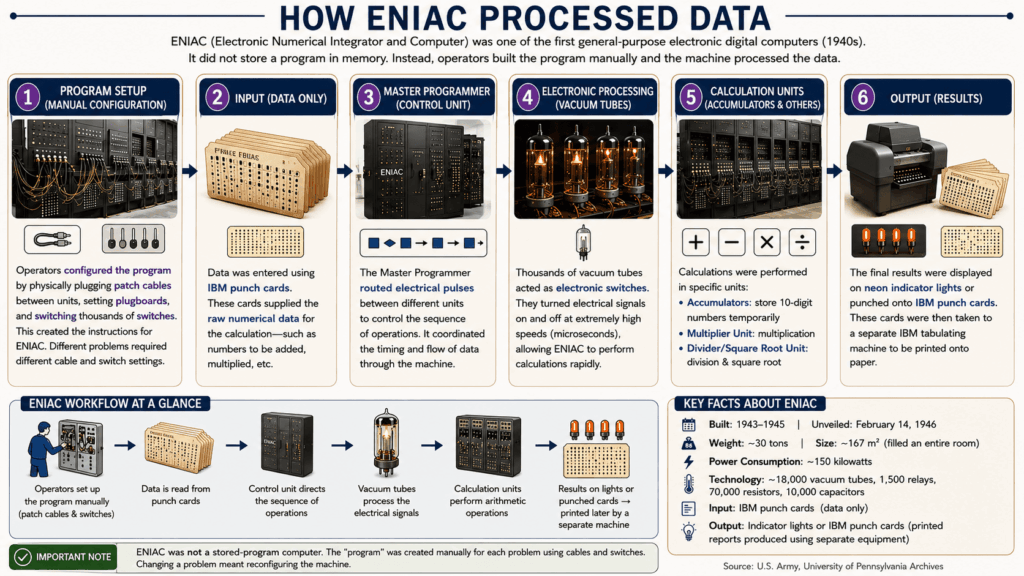
ENIAC did not use programming languages or stored software. Instead, each problem had to be programmed manually by connecting patch cables, configuring plugboards, and setting thousands of switches.
This work was carried out by six pioneering women programmers:
- Jean Jennings Bartik
- Kathleen McNulty
- Betty Snyder Holberton
- Marlyn Wescoff Meltzer
- Ruth Lichterman Teitelbaum
- Frances Bilas Spence
These women analysed mathematical problems, developed programming methods, configured ENIAC for different calculations, tested the machine, and helped demonstrate its capabilities. Their contributions were overlooked for many years but are now widely recognised as a significant part of computing history.
When Was ENIAC Built?
The ENIAC project began in 1943.
Construction continued throughout World War II, and the machine became operational in 1945. It was then publicly announced in February 1946, attracting worldwide attention and establishing itself as a landmark achievement in computing history.
Where Was ENIAC Built?
Engineers built ENIAC at the Moore School of Electrical Engineering, part of the University of Pennsylvania in Philadelphia, United States.
At that time, the university served as one of the leading centres for engineering research.
The project received financial support from the United States Army, reflecting the urgent need for faster military calculations during World War II.
How Did ENIAC Work?
Today’s computers execute programs with just a click. However, ENIAC worked very differently. It did not have an operating system, a keyboard, a mouse, or a graphical interface. Instead, programmers had to prepare the machine manually before it could solve a problem.
ENIAC processed information electronically using thousands of vacuum tubes, switches, and electrical circuits. Rather than storing programs in memory like modern computers, it relied on cables and switches to define the sequence of operations.
A Simple Analogy: Imagine you have a large railway network.
- The train represents the data (numbers).
- The tracks represent the wires and cables.
- The stations represent different sections of ENIAC.
Before the train could travel, workers had to arrange the tracks correctly. Likewise, before ENIAC could perform calculations, programmers connected patch cables and adjusted switches to create a program.
Once everything was configured, ENIAC processed the numbers automatically and produced the required results.
The Main Components of ENIAC
Although ENIAC looked like one giant machine, it actually consisted of many interconnected units. Each unit performed a specific task.
Vacuum Tubes
Vacuum tubes acted as electronic switches. They controlled the flow of electricity and allowed ENIAC to perform calculations electronically instead of mechanically.
ENIAC contained approximately 17,468 vacuum tubes.
Accumulators
An accumulator was similar to a temporary storage location.
It could:
- Store numbers
- Add numbers
- Subtract numbers
- Pass results to other parts of the machine
ENIAC contained 20 accumulators, each capable of storing a 10-digit decimal number.
Function Tables
Function tables stored numerical values used repeatedly in calculations.
For example, instead of calculating the same mathematical values over and over, ENIAC could retrieve them from these tables, saving time.
Control Unit
The control unit coordinated the machine’s operations. It ensured that each component performed its task in the correct sequence.
Input and Output Devices
Unlike modern computers, ENIAC did not use a monitor or keyboard.
Instead, operators entered data using:
- Punch cards
- Switch panels
The machine produced results through punched cards or printed output, depending on the application.
Key Features of ENIAC
Several characteristics made the Electronic Numerical Integrator and Computer unique.
Electronic Operation
Unlike earlier mechanical machines, ENIAC performed calculations electronically. As a result, it operated much faster than its predecessors.
High-Speed Calculation
ENIAC could perform approximately:
- 5,000 additions per second
- Hundreds of multiplications each second
For the 1940s, this speed was extraordinary.
General-Purpose Design
Unlike machines designed for only one task, ENIAC could solve many different mathematical problems after being reconfigured. This flexibility made it one of the first general-purpose electronic computers.
Decimal Number System
Modern computers use the binary number system (0s and 1s). However, ENIAC performed calculations using the decimal system, making it easier for engineers and mathematicians of that era to understand.
Massive Size
ENIAC occupied approximately 1,800 square feet (about 167 square meters). It stretched across multiple large cabinets installed around an entire room.
Heavy Weight
The complete machine weighed nearly 30 tons. Transporting or relocating ENIAC was a major engineering challenge.
Huge Power Consumption
ENIAC required around 150 kilowatts of electrical power. This was enough electricity to power many homes at the time.
Advantages of ENIAC
Although ENIAC seems primitive compared to today’s computers, it offered remarkable advantages for its time.
Extremely Fast Calculations
The greatest advantage of ENIAC was its speed. Problems that previously took several days could now be solved in minutes or even seconds.
Improved Accuracy
Manual calculations often introduced human errors. Because ENIAC performed calculations electronically, it produced highly accurate results when programmed correctly.
General-Purpose Computing
ENIAC was not limited to a single application. Engineers could configure it to solve different scientific and mathematical problems, making it highly versatile for its era.
Reduced Human Workload
Instead of performing thousands of repetitive calculations manually, scientists could let ENIAC complete the work automatically. This saved both time and effort.
Foundation of Modern Computing
Perhaps ENIAC’s greatest contribution was proving that electronic digital computers were practical. Without ENIAC, the rapid development of modern computers might have taken much longer.
Disadvantages of ENIAC
Like every early invention, ENIAC also had several limitations.
Very Large
ENIAC occupied an entire room. Today, a smartphone can perform far more calculations while fitting comfortably in your hand.
Consumed Huge Amounts of Electricity
Its power requirements were enormous.
Operating ENIAC was expensive because it consumed about 150 kW of electricity continuously during operation.
Generated Significant Heat
Thousands of vacuum tubes produced a great deal of heat. Therefore, engineers had to ensure proper cooling to keep the machine running reliably.
Difficult to Program
Programming ENIAC was a manual process. Changing from one task to another often required reconnecting cables and adjusting hundreds of switches. Depending on the complexity of the problem, this process could take several hours or even days.
Frequent Hardware Failures
Because ENIAC contained thousands of vacuum tubes, component failures occurred regularly. Maintenance engineers continuously monitored the machine and replaced faulty tubes to keep it operational.
Where Is ENIAC Today?
Many people wonder whether ENIAC still exists. The answer is yes, but not as a complete machine.
After ENIAC was retired in 1955, the system was dismantled. However, several of its original panels and components were preserved because of their historical importance.
Today, you can see ENIAC components in several museums across the United States, including:
- The University of Pennsylvania (Philadelphia)
- The Smithsonian Institution (Washington, D.C.)
- The Computer History Museum (Mountain View, California)
- Other science and technology museums that preserve early computing artefacts
These exhibits help visitors understand how the Electronic Numerical Integrator and Computer transformed the world of technology.
Interesting Facts About ENIAC
Here are some fascinating facts you can use for school assignments, quizzes, or interviews.
- ENIAC was enormous.
- It weighed nearly 30 tons, making it one of the largest electronic computers ever built.
- It used approximately 17,468 vacuum tubes.
- These tubes acted as electronic switches and enabled high-speed calculations.
- ENIAC consumed about 150 kilowatts of electricity.
- Its energy requirements were much higher than those of modern personal computers.
- It filled an entire room.
- Unlike today’s compact devices, ENIAC required a dedicated space with multiple equipment cabinets.
- Programming was completely manual.
- Engineers used cables, plugs, and switches to configure the machine for different tasks.
- It revolutionised computing.
- ENIAC demonstrated that large-scale electronic computing was practical, inspiring the development of later computers with stored-program architecture.
Quick Revision Table
| Topic | Key Point |
|---|---|
| Full Form | Electronic Numerical Integrator and Computer |
| Developed By | John W. Mauchly and J. Presper Eckert |
| Project Started | 1943 |
| Operational | 1945 |
| Publicly Announced | February 1946 |
| Built At | University of Pennsylvania, USA |
| Primary Purpose | Calculate artillery firing tables |
| Technology Used | Vacuum tubes |
| Number of Vacuum Tubes | Approximately 17,468 |
| Weight | About 30 tons |
| Power Consumption | Around 150 kW |
| Programming Method | Patch cables and switches |
| Number System | Decimal |
| Current Status | Preserved in museums as historical exhibits |
What You Have Learned So Far About ENIAC
Great! You have successfully completed this beginner-friendly guide to the Electronic Numerical Integrator and Computer (ENIAC).
By now, you should have a clear understanding of:
- What ENIAC is
- What ENIAC stands for
- Why ENIAC was invented
- Who invented ENIAC
- When and where ENIAC was built
- How ENIAC works at a basic level
- Its major components
- Its key features
- The advantages and disadvantages of ENIAC
- Where ENIAC is preserved today
- Why ENIAC remains one of the most important milestones in the history of computing
With these fundamentals in place, you have built a strong foundation for understanding the evolution of modern computers.
Wrapping Up – ENIAC [Electronic Numerical Integrator And Computer] – Complete Guide for Beginners
The Electronic Numerical Integrator and Computer (ENIAC) marked the beginning of a new era in computing. Although it occupied an entire room and relied on thousands of vacuum tubes, it demonstrated that electronic machines could solve complex mathematical problems far more quickly than manual methods or mechanical calculators.
Today, computers are smaller, faster, and significantly more powerful than ENIAC. However, the pioneering ideas behind ENIAC helped shape the development of modern computer systems. Understanding its history not only provides insight into the origins of digital computing but also helps us appreciate the remarkable progress technology has made over the decades.
Whether you are a school student, a beginner exploring computer fundamentals, or someone preparing for higher studies, learning about ENIAC is an important step toward understanding the fascinating evolution of computers.
Continue Your Learning
Now that you understand the fundamentals of ENIAC, you may be wondering how this remarkable machine actually worked behind the scenes.
In this beginner’s guide, we focused on the history, purpose, features, and basic operation of ENIAC. However, the engineering behind the Electronic Numerical Integrator and Computer is equally fascinating.
In our next tutorial, ENIAC Architecture and Working: An Advanced Guide, you’ll explore:
- The internal architecture of ENIAC
- How vacuum tubes processed data
- The role of accumulators and function tables
- How ENIAC was programmed using patch cables and switches
- The Master Programmer and Control Unit
- ENIAC’s performance and limitations
- How ENIAC influenced modern computer architecture
- ENIAC vs. EDVAC and modern computers
If you’re a BCA, B.Tech, diploma, computer science, or cybersecurity student – or simply want to deepen your understanding of computer architecture – this advanced guide is the perfect next step.
Stay Connected & Keep Learning!
Did you find our articles and tutorials helpful? Stay updated with more expert tips – Follow us on Facebook and Instagram!
Be Part of a Global Tech Network! Join our Official Facebook Group for live Q&A, discussions, and networking with a global tech community!



Pingback: ENIAC Architecture and Working Explained: Inside the First Electronic Digital Computer - Ofbit.Org